

Danh từ, động từ và tính từ là những loại từ nền tảng trong tiếng Anh, nhưng nhiều bạn vẫn dễ nhầm lẫn về vị trí, chức năng và cách sử dụng của từng loại từ. Điều này khiến không ít bạn mất điểm khi làm bài tập hoặc các bài thi.
Để giúp bạn nắm vững kiến thức, bài viết này tổng hợp 100+ bài tập về danh từ, động từ và tính từ có đáp án chi tiết, giúp bạn luyện tập từ cơ bản đến nâng cao và sử dụng chính xác các loại từ trong từng ngữ cảnh.
Bài viết bao gồm:
- Tóm tắt kiến thức về danh từ, động từ và tính từ.
- Thực hành 100+ bài tập danh từ, động từ và tính từ theo nhiều dạng.
- Download file PDF bài tập có đáp án.
Hãy cùng mình bắt đầu ngay!
1. Ôn tập kiến thức về danh từ động từ tính từ
Đầu tiên, bạn hãy cùng mình ôn tập lại kiến thức về danh từ động từ tính từ trước nhé.
| Tóm tắt lý thuyết từ loại trong tiếng Anh |
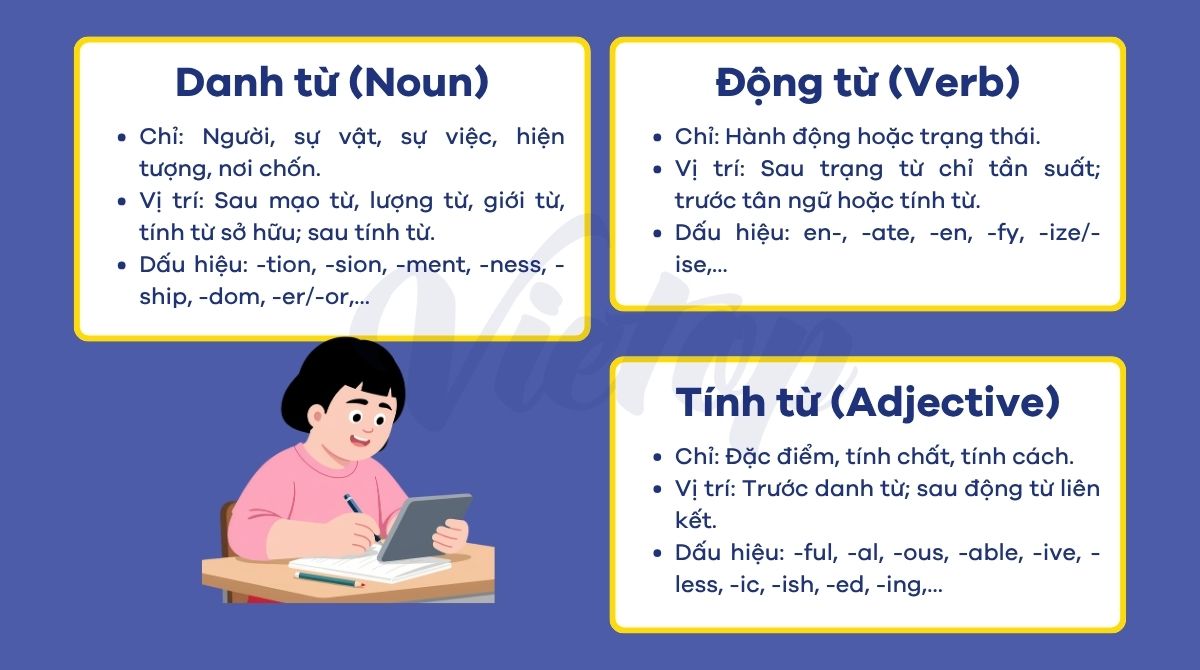
| 1. Danh từ – Định nghĩa: Danh từ là loại từ chỉ người, chỉ sự vật, sự việc, hiện tượng hoặc nơi chốn. – Vị trí của danh từ trong câu: Đứng sau mạo từ, sau lượng từ, sau từ hạn định, sau tính từ sở hữu, sau giới từ. – Dấu hiệu nhận biết: Danh từ có thể được nhận biết thông qua các hậu tố như -tion, -sion, -ment, -ce, -ness, -y, -er/or, -ship, -dom, -ism, -an/ -ian, -age, -hood, … 2. Động từ – Định nghĩa: Động từ là những từ chỉ hành động, trạng thái của một sự vật, hiện tượng nào đó. – Vị trí của động từ trong câu: Đứng sau trạng từ chỉ tần suất, đứng trước tân ngữ, đứng trước tính từ. – Dấu hiệu nhận biết: Động từ có thể được nhận biết thông qua các tiền tố như en-, … và hậu tố như -ate, -en, -fy, -ize/ ise, … 3. Tính từ – Định nghĩa: Tính từ là những từ để miêu tả đặc điểm hoặc tính cách của con người, sự vật và hiện tượng. – Vị trí của tính từ trong câu: Đứng trước danh từ, sau động từ liên kết. – Dấu hiệu nhận biết: Tính từ có thể được nhận biết thông qua các hậu tố như -ful, -al, -ous, -able, -ive, -less, -ible, -ly, -y, -ic, -ish, -ed, -ing. |
Thực hành thêm các dạng bài tập sau:
2. Bài tập về danh từ động từ tính từ trong tiếng Anh
Để giúp bạn ôn tập và củng cố kiến thức, bộ tài liệu tổng hợp các dạng bài tập thường gặp về danh từ, động từ và tính từ, bao gồm:
- Biến đổi từ loại.
- Bài tập tìm lỗi sai.
- Sắp xếp từ hoàn thành câu.
- Chọn từ thích hợp để điền vào chỗ trống.
- Điền từ thích hợp vào đoạn văn.
Exercise 1: Changing word types (Word Form)
(Bài tập 1: Biến đổi từ loại (Word Form))
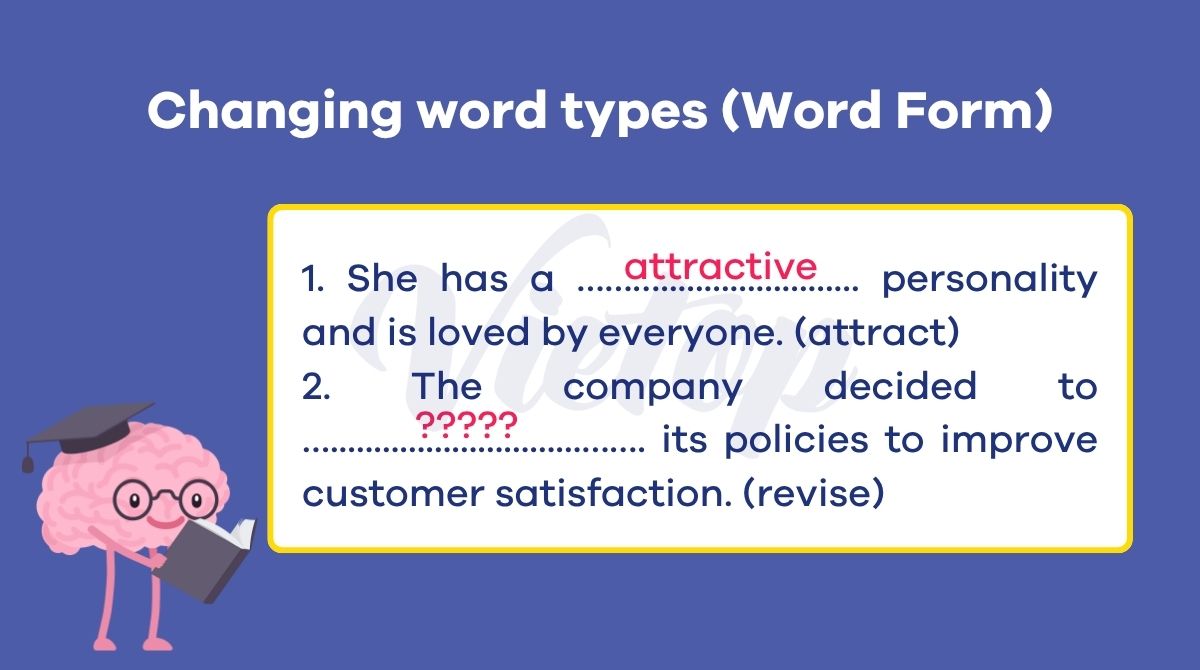
1. She has a ………. personality and is loved by everyone. (attract)
2. The company decided to ………. its policies to improve customer satisfaction. (revise)
3. He showed great ………. when faced with a challenging situation. (courageous)
4. The chef prepared a ………. meal that delighted all the guests. (taste)
5. The ………. of the new technology has transformed our daily lives. (appear)
6. He made a very ………. speech at the ceremony. (impress)
7. The ………. of the new law was a significant moment for the country. (introduce)
8. She was ………. to see her old friend after so many years. (delight)
9. The weather was ………. bad, so we decided to stay indoors. (exception)
10. His ………. in the project was highly appreciated. (involve)
11. The ………. of the event was beyond our expectations. (organize)
12. She showed great ………. in dealing with the difficult situation. (patient)
13. The ………. of the movie was praised by critics. (direct)
14. His ………. for the job was evident from his resume. (qualify)
15. They were ………. about the results of the experiment. (doubt)
16. The ………. of the festival attracted many tourists. (celebrate)
17. Her ………. in the classroom was always disruptive. (behave)
18. The ………. of the products is very important for the company. (produce)
19. He has a ………. approach to solving problems. (science)
20. The ………. of the book made it a bestseller. (popular)
21. Her ………. to the project was invaluable. (contribute)
22. The ………. of the food was amazing. (prepare)
23. He gave a very ………. explanation of the process. (detail)
24. The ………. of the team was questioned after their loss. (effective)
25. She was ………. with the results of her hard work. (satisfy)
Exercise 2: Exercise to find errors in the following sentences
(Bài tập 2: Bài tập tìm lỗi sai trong các câu sau)
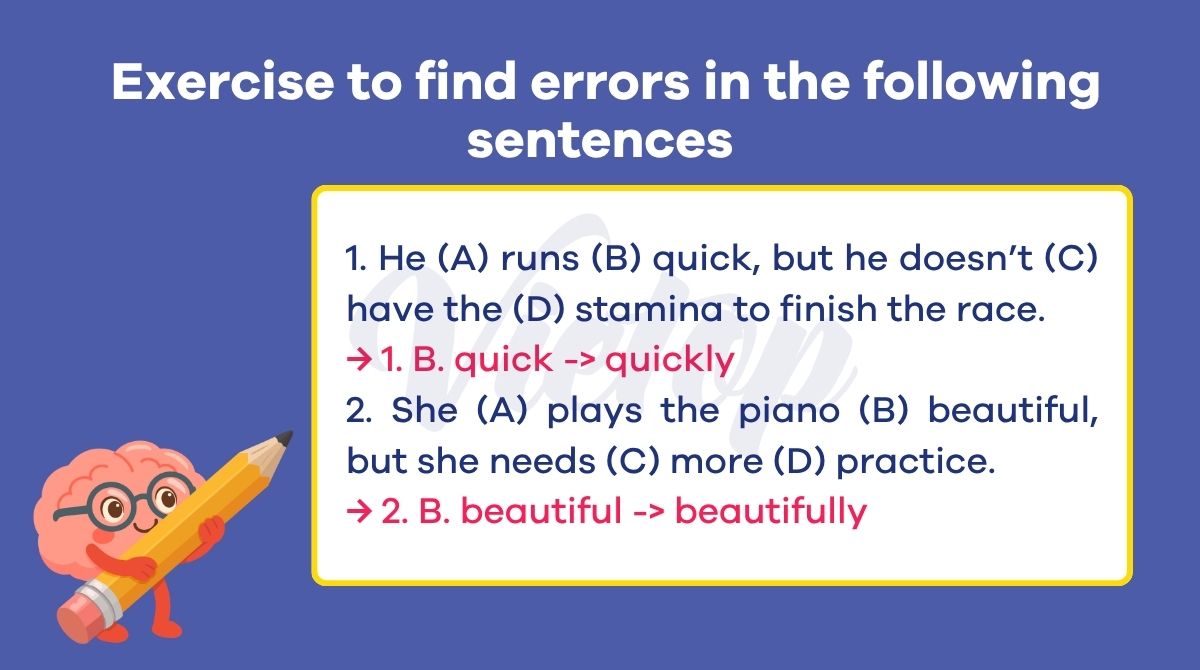
1. He (A) runs (B) quick, but he doesn’t (C) have the (D) stamina to finish the race.
2. She (A) plays the piano (B) beautiful, but she needs (C) more (D) practice.
3. The (A) flowers in the garden (B) smells (C) wonderful (D) in the springtime.
4. He (A) did his homework (B) careful, but still (C) made a lot of (D) mistakes.
5. She (A) can speak (B) English (C) fluent (D) after living in the US for five years.
6. The (A) teacher was (B) angry because the students were (C) talking (D) noise.
7. We (A) need to (B) finish this project (C) as (D) quick as possible.
8. The (A) baby slept (B) peaceful (C) after (D) drinking her milk.
9. He (A) always (B) answers (C) questions (D) honest.
10. The (A) athlete (B) performed (C) incredible well (D) at the competition.
Exercise 3: Arrange the words to complete the sentence
(Bài tập 3: Sắp xếp từ hoàn thành câu)
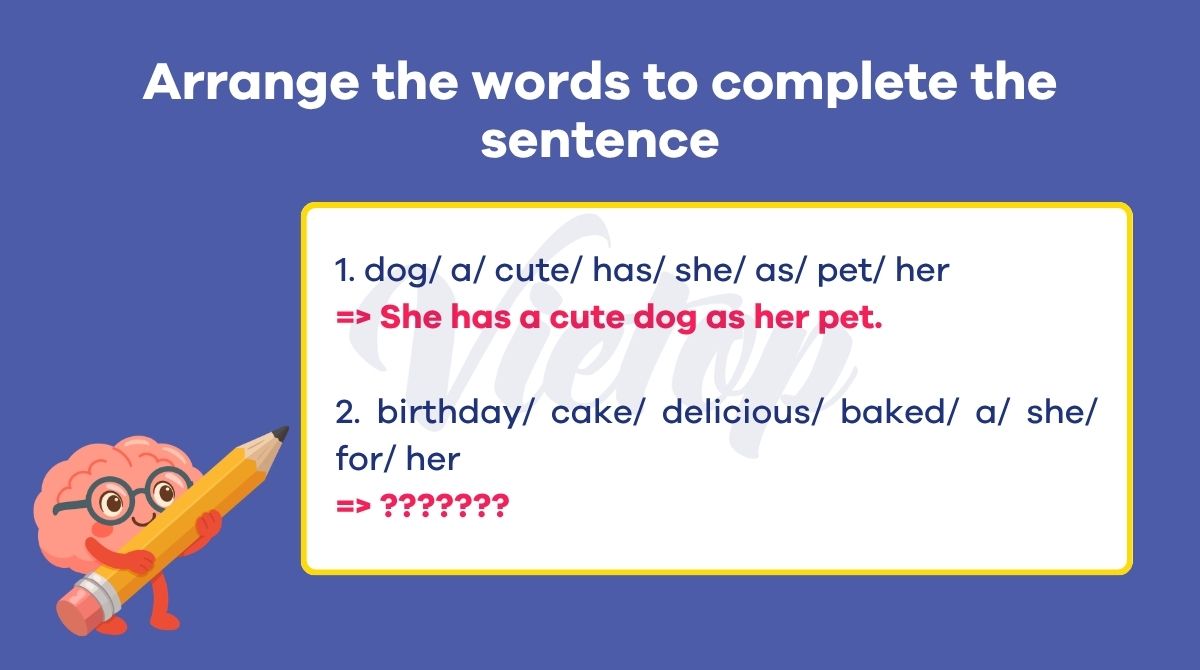
1. dog/ a/ cute/ has/ she/ as/ pet/ her
=> ……………………………………………………
2. birthday/ cake/ delicious/ baked/ a/ she/ for/ her
=> …………………………………………………
3. bicycle/ his/ daily/ to/ rides/ school/ he
=> ……………………………………………………
4. purchased/ new/ just/ house/ a/ they
=> ……………………………………………………
5. she/ every/ studies/ night/ late/ until
=> ……………………………………………………
6. planted/ in/ flowers/ garden/ colorful/ the/ they
=> ……………………………………………………
7. dog/ the/bone/ buried/ a/ backyard/ in/ the
=> ……………………………………………………
8. the/ new/ has/ announced/ plan/ government/ the
=> ……………………………………………………
9. chef/ prepared/ gourmet/ the/ meal/ a
=> ……………………………………………………
10. wrote/ famous/ a/ novel/ the/ author/ best-selling
=> ……………………………………………………
Exercise 4: Choose the appropriate word to fill in the blank
(Bài tập 4: Chọn từ thích hợp để điền vào chỗ trống)
1. The new restaurant has received ………. reviews from food critics.
- A. rave
- B. ravished
- C. raving
- D. ravishly
2. He ………. the importance of being punctual in his speech.
- A. stress
- B. stressed
- C. stressing
- D. stressingly
3. The ………. of the ancient artifact attracted many historians.
- A. discoveries
- B. discovering
- C. discovery
- D. discover
4. The team’s ………. efforts led to their victory.
- A. collaboration
- B. collaborate
- C. collaboratively
- D. collaborators
5. The book provides a ………. overview of the topic.
- A. comprehensive
- B. comprehend
- C. comprehending
- D. comprehensively
6. She showed ………. in her ability to solve complex problems.
- A. competence
- B. competent
- C. competently
- D. compete
7. The medicine must be taken ………. for it to be effective.
- A. regular
- B. regulate
- C. regularly
- D. regulations
8. The ………. landscape was breathtaking.
- A. nature
- B. natural
- C. naturally
- D. naturalist
9. The company’s new policy aims to ………. customer satisfaction.
- A. enhance
- B. enhanced
- C. enhancing
- D. enhancement
10. The ………. of the situation was not immediately apparent.
- A. serious
- B. seriousness
- C. seriously
- D. seriosity
Exercise 5: Fill in the appropriate words in the passage
(Bài tập 5: Điền từ thích hợp vào đoạn văn)
[…] Tigers in the wild are known for their (1) ………. hunting skills that they use to capture prey such as deer and wild boar. Research has shown that (2) ………. average, tigers in the Siberian region of Russia have larger territories compared to those in Southeast Asia.
The territorial boundaries are often (3) ………. marked by scent glands along the perimeter. Dr. Michael K. Robinson, a wildlife biologist, mentioned that it is (4) ………. to observe that, when a young male and female tiger are near a river, ‘he’s sharpening his claws, while she’s (5) ………. bathing in the shallows.’ Dr. Robinson and his team are studying tigers in a reserve with remote camera traps, using infrared sensors instead of traditional film.
Question 1:
- A. stealth
- B. stealthy
- C. stealthily
- D. stealthiness
Question 2:
- A. on
- B. in
- C. at
- D. by
Question 3:
- A. clearly
- B. clear
- C. cleared
- D. clearing
Question 4:
- A. curiosity
- B. curious
- C. curiously
- D. curiousest
Question 5:
- A. lazily
- B. lazy
- C. laze
- D. lazing
3. Tải tài liệu bài tập về danh từ động từ tính từ
Để thuận tiện hơn cho việc làm các bài tập tự luyện, mình đã giúp bạn tổng hợp một file với đầy đủ bài tập và đáp án. File được chia sẻ hoàn toàn miễn phí. Hãy tải về và làm bài cùng mình thôi!
4. Kết luận
Cũng như khi luyện tập các điểm ngữ pháp khác, trong quá trình làm bài tập về danh từ động từ tính từ, nhiều bạn thường mắc phải những lỗi sau. Hãy lưu ý để tránh mất điểm đáng tiếc nhé!
- Nhầm lẫn giữa danh từ, động từ và tính từ do chưa xác định đúng chức năng của từ trong câu.
- Chọn sai dạng từ vì không chú ý đến vị trí hoặc các dấu hiệu nhận biết.
- Không biến đổi từ phù hợp với ngữ cảnh, chẳng hạn chuyển từ động từ sang danh từ hoặc tính từ khi cần thiết.
- Chỉ ghi nhớ lý thuyết mà chưa luyện tập thường xuyên nên dễ lặp lại các lỗi sai.
Ngoài ra, để hiểu rõ hơn về danh từ, động từ, tính từ cũng như các chủ điểm ngữ pháp quan trọng khác, bạn có thể tham khảo và tải miễn phí các bộ tài liệu, bài tập trong kho tài liệu IELTS Grammar trên website Vietop English để tiếp tục ôn luyện hiệu quả hơn.
Tài liệu tham khảo:
- What Is a Noun? Definition, Types, and Examples – https://www.grammarly.com/blog/nouns/ – Truy cập 10/7/2024.
- What Is an Adjective? Usage and Examples https://www.grammarly.com/blog/adjective/ – Truy cập 10/7/2024.
- Verbs: The Definitive Guide – https://www.grammarly.com/blog/verbs/ – Truy cập 10/7/2024.


 Thanh Đạo


 Trang Jerry